Thursday, April 17, 2014

Great insights have come to some people only after they reached the point where they had nothing left... To resolve the dichotomy of the civilized and the wild, we must first resolve to be whole." - Gary Snyder, The Practice of the Wild

All these years I could not find my own voice. I popped out on the other side frightened, lying about my age already, and investigating all my grey hair. It is difficult to believe that years can pass so quickly, and they are never given back. 

I thought it had to do with my grandfather's passing. He died on a blustery day in November when I was 25 years old. He was a rare and dynamically kind, compassionate and intelligent man with a penchant for bringing out the best in others. We did not understand he kept our family together until he was gone. And he was gone suddenly. I never had the chance to say good-bye. None of us did. It is difficult to resolve how a thing like that can happen, one unassuming day a grounding force and a source of unconditional love can leave this world forever. I've tried all those tricks, remembering him, and trying to honour him with how I live today. It isn't enough. It has been a few years now. I still long to hear his soft, growling voice, or see the little freckles that used to cover his hands. I can't even come close to describing the loss.

When I learned of his death, I was immediately afraid he lived quietly disappointed in me. At the time, I remember thinking that was such an ego-centric first reaction. But there it is. I worried I had not lived up to his expectations. I had little to no accomplishments at the time of his death, aside from frequently going off to hike deep into the back-country, to camp and explore on my own. Or I would travel around like a privileged vagrant, driving around on the prowl. Neither of us knew that his presence on this Earth gave me the courage to wander and chase down a sense of freedom.

Despite being unable to answer the questions, "Who am I?' 'What am I doing here?' 'What's going on?' I now feel more certain he would be proud of me, then and now. He was a man of science, a BC Wildlife researcher and a professor at various universities as he held a Ph.D in Zoology. Some species of animal exist in abundance rather than scarcity as a result of his fine work. He would be pleased to know I am conducting first level medical evidence and presenting my projects at various conferences. He would especially enjoy that the research is independent and unaffiliated with the pharmaceutical industry. He would have been thrilled when I won a scholarship to meet a Nobel-laureate at a small, invite-only gathering in Boston.

He wouldn't have said much about it, had he lived, but I think he would be secretly relieved that I am embarking on my own again. Or perhaps it is simply the conviction of my own relief. He never lived to see me go through my days with such a sense of fear and stress and insecurity. Whoever I have become is not the person I wish to remain. The hardest decision was in the act of leaving. But what drove me to do it was the understanding that there are no guarantees after this one life. I knew that I had lost myself along the way. And I understood that things fall apart. For years I had been trying to pick up the pieces of a relationship when I myself was broken.

Just because I feel relief does not always spare me from feeling embittered, or lonely, or even from spats of self-loathing. It is slippery when you first begin to let go of your own voice, and before you know it, years have passed. You wake up one morning and realize it isn't easy to live each day without a sense of like or love for yourself, and without any understanding of your own identity or worth. It is not enough to dress the part of success. I want to be whole again. I want to easily create joy for myself and have a sense of peace and fulfillment. I wish to be surrounded by true friends, who are good for me and I for them. It is not too much to ask.

A new path is being formed. It is good, important and necessary, despite all that remains unknown.

Onwards! 

Thursday, April 5, 2012

“And I said, 'That last thing is what you can't get, Carlo. Nobody can get to that last thing. We keep on living in hopes of catching it once and for all.” Jack Kerouac, On the Road


 Friends,

I have been absent in more ways than one. There has been a long silence, while I keep my life and thoughts mostly in the dark. I'm not sure how this came about. Perhaps I lost the courage to share, or stopped giving myself permission, or dismissed my reflections as unimportant. Sometimes it is easy to become hard on yourself.

I tried writing throughout the months, but could never bring myself to make it known. Hidings and secrets. It can be easier to remain quiet, to avoid judgment and scrutiny, and self-doubt.


___________________________________________________


August 2011

During the month of August I had a birthday. Turning 25 was the first birthday I both dreaded and disliked immensely. I woke up that day feeling unversed, unsuccessful, untraveled, all of which I felt in equal measure. Simply awful. 

The morning of my birthday, relatives crowded around the patio table for a blueberry pancake breakfast that my aunt had prepared in my honour. The younglings gabbed away in their talk of tweens, happily oblivious that their biggest mistakes are yet to happen, and that they have their whole lives sprawled out ahead of them, laying in wait, and I sat there all antsy and teary-eyed, terrified of failure, and being divorced, raising my children to be convicts, developing arthritis, god only knows what else, becoming fat, and missing my mother, and just generally feeling sorry for myself.

After breakfast I drank some wine, and the world turned itself right-side-up again, and remained that way for the most part, despite a wasp stinging me just before I jumped off a bridge. I only jumped because everybody else was doing it, and by that I refer to the children in their youthful glory. They can do anything un-phased. I did not want to jump, but I did because I am afraid to grow old, and it seemed that someone young and carefree might do this sort of thing. I was stiff as a board when I hit the water, and I felt my spine all the way to my neck do a little switcheroo, click snap, though nothing was broken or anything really, just angry as hell. I think I had whiplash. I bought muscle relaxants, little white pills that made me high. Best birthday gift ever, not that I condone that sort of thing, because I don't. However, I took to being this way on the day I turned quarter of a century, and accepted my new speaking accent, which sounded to me like a blend of South African and Australian. I bought into it and felt alright.

___________________________________________________

September 2011

"I like days like this," Michael says, standing near the window of his apartment. Gray outside, misting, cool -- the snap of Autumn, the one we've been smelling with our noses for weeks.

One evening just about about a month back, you could have found me sitting in the front yard of my grand-parents house, the summer still wrapped around me as though I were a child. There were fifteen of us there if I exaggerate: three large dogs, one fat cat, four rambunctious kids, seven adults, one of them being me. 

During the night in question, I was at the patio table with a glass of red wine in hand, phone in the other, while the kids darted back and forth with flashlights, playing hide-and-go-seek as the last of daylight waned. It was twilight, that window of time where the sky hangs a memorable blue, one we all know, though it is difficult to describe: a magical, evasive colour that hints something deeper is coming.

Many evenings I would sit in the grass, watching the little insects crawl, or the waves of the lake make their way towards the shore. There is a safety that cannot be savored enough when you are among people who love you, who really truly love you.

"We're going to do more of the things you love," Michael said to me over the phone. "When you get back, we'll go into the mountains. Every chance we get."

Our first date had been the last game of the Stanley Cup finals, when the city of Vancouver errupted in riots. When the glass bottles began to fly, Michael wrapped his large arms around my head and carted me out of there, chatting casually the entire way. At a safe distance he let go. I was in one of those moods, nonchalant and carefree. I wandered off at one point, which he responded to by taking a fistful of my hair, pulling me back to him where it was safe. I knew I loved him then, though I didn't say as much.

We wound up at the large bus depot downtown, the old building that reads Pacific Central, and has lots of drunkards sleeping on benches in the park. I wanted to run through the grass in my bare feet.

"Do you want to go to Alberta?" he asked me, feigning to take out his wallet. "You want to make a run for it, just you and me?"

When I took off my shoes to do exactly as I had said, he threw me over his shoulder, stooping to pick up my shoes saying, "Not in this park."
 
___________________________________________________


It didn't get easier. It is not always easy.
More to come.

- Kendra


Monday, September 26, 2011

The violets in the mountains have broken the rocks. -Tennessee Williams


Fall is with me now. I find that the wind sounds different, the way it rustles through the autumn coloured leaves -- gold, crimson, and that deep, warm orange. The leaves even look different, blowing in their trees, lighter and thrilled, and eager. This morning I awoke, while Michael was still sleeping beside me, to the sound of roaring air outside the open window, a soft, wet, drenched world of rain, and wind, and new weather.

As summer wanes, so come the days that have a snap in the air, not quite cold, but brisk and fresh, the burgeoning of something different that we can smell with our noses. The light of afternoon is sharper, but not revealing. And the hotter days feel uncomfortable, already foreign and out of place. There is an excitement to fall, an unpredictability, and with it the abrupt passing of summer, all of which I am constantly resisting. It is this truth about fall that prods at my old, cold memories, that change is happening all around me, whether I am ready for it or not. 

Autumn represents a mystery of sorts, for even the birds seem quieter these mornings, as though they are listening to whisperings that I can't quite make out. Or perhaps they are just preserving their energy, staying warm by flocking together on the tops of roofs, out of sight, huddled and praying. The season speaks to my heart about uncertainty. There's a part of me that feels unready for what's approaching. I want to walk into a thicket of trees; I want to find a place to sleep there, far away, feel my steps sink a little, against soft wood chips and moss, run my fingers over slick, wet bark, and forget everything.

I can't seem to let go of the warmer months, the hot luxury of it, the long days, the slow, easy nights that linger, and turn into dark violets without the hint of ending. I have always been wildly romanced and intoxicated with the richness of summer. But it isn't just the weather that I miss. Times that have meant so much to me -- are gone. If I could crawl through the passage of time, I would go back to see if there's a difference between growing pains and what I feel now. I would go back to hear laughter and voices I once knew, or ones that I still know, but can't listen to anymore. I took a walk on the shore of the sea today, where we all blew in the wind and had water hang off our eyelashes, the tips of our noses, and the ends of our hair. There was so much I wanted to say, but I just haven't been able to, for lack of courage, or identity, I just can't seem to say it all. 

The greatest secret is in the trees, especially this time of year. Watch the way they move, lay your hands on them at your lowest, most desperate moment. Don't be bitter, they seem to say, we know how you think.

Friday, August 5, 2011

"Good land, Wild land, Sacred land." -Gary Snyder

The last three weeks I have been gradually moving away from my better self. I wasn't making time for what I loved: ascending the heights, clambering up rocks, touching the bark of trees, listening to the sounds of birds, water and wind. Being in the natural world. In the face of obligations and deadlines, I unknowingly dismissed my best self, my wild self, the separation from which became increasingly painful.

The first sign, and one that I missed, was that friends began to remark that I seemed different, and proceeded to ask whether I was doing alright.  
Oh fine, I'd say, maybe a little restless.

The restlessness became something else, and not something I could shake off with any number of long walks at the beach. Nor any amount of sitting in the grass, basking under the sun, playing with the dog, or holding long headstands -- the restlessness would not abate, and after a week or so it welled up inside of me, not long after which transforming into something else entirely: suspicion, angst, doubtfulness, and self-defeating thoughts.

Like so many others, I've been conditioned to put on a brave face, despite the many signs that something is awry. I ignored the signs and carried on, albeit with a sense of unease. There is no flow here, in a state like this, and the source of kindness is forgotten. Yet at the same time, it can be surprisingly difficult to know where exactly you made the wrong turn; it can be hard to articulate what held you together to begin with, and when you began to forsake them. Though I sensed the shift in my demeanor, I wanted to believe it would just pass, that I could go on living without really taking care of myself.

One night, a gorgeous, warm, soft summer's night, I walked a long ways down the beach where I live, and waded into the water. The waves were rolling and swelling with the tide, and I felt a part of it, that something magical and sacred was happening, and it felt wondrously overwhelming. I came across a rock on which I sat for a time. There I began to weep with abandon, and I felt like an animal, without a care for dignity. I was gloriously alone, and my heart felt sick.

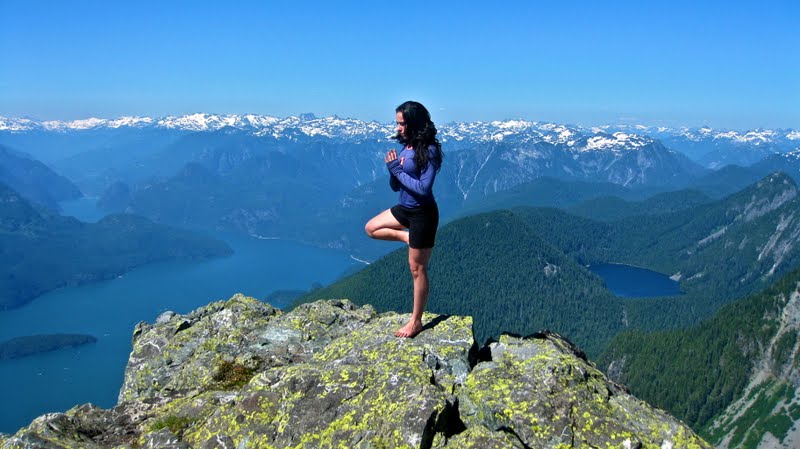
It was not long after this night that I went back into the mountains. I purposely chose the West Canyon Trail in Golden Ears Provincial Park, not only because it is a sacred place to me, where I have brought many friends, and where I have practiced asana on top of the world, but I chose to venture into this place because the trek is so very long. I knew that I had become disjointed from the world around me, my loved ones, myself, and the precious wild. You cannot just snap yourself back into union. It requires on some level a process of exhaustion, and sacrifice. And that can take time.

I sought solace and solitude, purposely setting out on the trail without any companions. It felt good to be there by myself, without the need for words, or to appear any which way -- I let the sweat drip off my nose and forehead, stretched myself over rocks, climbed up the long, strong roots of old trees, strained my eyes under the sun, and allowed the maddening amount of bugs to crawl over my face and arms and legs. All was well in my world, to expend my energy in a place so worthy of my time and love.

On the last stretch of trail, ten hours after first setting out, I was in a place of much more clarity. There in my sanctuary I had renewed myself to letting go of disappointments, my fear of failure, and my desire to control what remains unknown to me. I had begun the process of being more compassionate, reminding myself that I am vast, and that there is room within my being not only for my strengths, but for my shortcomings. Along the way, I had sweated through many of the toxins that had accrued over time, what had caused unbearable anxiety, and I offered them as a wordless prayer. I believe there is a better way to live: with strength and determination, with reverence for the source of kindness, compassion and intuition, and most importantly perhaps, I believe I can be ever yielding to all that might happen along the way, and that I have the choice to be grateful and soft to the experience of life itself. Should I veer off this path again, I know the place where I can go to find myself -- my truest self, my best self, my wild self. 

Below are photos from four different occasions at Golden Ears, along with poignant excerpts from Gary Snyder's The Practice of the Wild.

"It has always been part of basic human experience to live in a culture of wilderness. There has been no wilderness without some kind of human presence for several hundred thousand years. Nature is not a place to visit, it is home."


"The land itself was their chapel and their shrines were hills and creeks and their religious relics were animals, plants, and birds. Thus the migrations of aboriginals, though spurred by economic need, were also always pilgrimages. Good (productive of much life), wild, (naturally), and sacred were one."

 
"The mountains and rivers of this moment are the actualization of the way of the ancient Buddhas. Each, abiding in its own phenomenal expression, realizes completeness. Because mountains and waters have been active since before the eon of emptiness, they are alive at this moment. Because they have been the self since before form arose, they are liberated and realized."


"Dogen (the Zen philosopher) is not concerned with 'sacred mountains'  -- or pilgrimages, or spirit allies, or wilderness as some special quality. His mountains and streams are the processes of this earth, all of existence, process, essence, action, absence; they roll being and non-being together. They are what we are, we are what they are. For those would see directly into essential nature, the idea of the sacred is a delusion and an obstruction: it diverts us from seeing what is before our eyes: plain thusness. Roots, stems, and branches are all equally scratchy. No hierarchy, no equality. No occult and exoteric, no gifted kids and slow achievers. No wild and tame, no bound or free, no natural and artificial. Each totally its own frail self. Even though connected all which ways; even because connected all which ways. This, thusness, is the nature of nature. The wild in wild."


"The world is as sharp as the edge of a knife - a Northwest Coast saying

"Human beings are audacious. They set out to have adventures and try to do more than perhaps they should. So by practicing yogic austerities or monastic discipline, some people make a structured attempt at having nothing. Some of us have learned much from traveling day after day on foot over snowfields, rockslides, passes, torrents, and valley floor forests, by 'putting ourselves out there.' A Tibetan saying has it: 'The experience of emptiness engenders compassion.'"


 "The lessons we learn from the wild become the etiquette of freedom. We can enjoy our humanity with its flashy brains and sexual buzz, its social cravings and stubborn tantrums, and take ourselves as no more and no less than another being in the Big Watershed. We can accept each other all as barefoot equals sleeping on the same ground. We can give up hoping to be eternal and quit fighting dirt. We can chase off mosquitoes and fence out varmints without hating them. No expectations, alert and sufficient, grateful and careful, generous and direct. A calm and clarity attend us in the moment we are wiping the grease off our hands between tasks and glancing up at the passing clouds. Another joy is finally sitting down to have coffee with a friend. The wild requires that we learn the terrain, nod to all the plants and animals and birds, ford the streams and cross the ridges, and tell a good story when we get back home."


"American society (like any other) has its own set of unquestioned assumptions. It still maintains a largely uncritical faith in the nation of continually unfolding progress. It cleaves to the idea that there can be unblemished scientific objectivity. And must fundamentally it operates under the delusion that we are each a kind of 'solitary knower' -- that we exist as rootless intelligences without layers of localized contexts. Just a 'self' and the 'world.' In there there is no real recognition that grandparents, place, grammar, pets, friends, lovers, children, tools, the poems and songs we remember, are what we think with. Such a solitary mind -- if it could exist -- would be a boring prisoner of abstractions. With no surroundings there can be no path, and with no path one cannot become free." 


"There is nothing like stepping away from the road and heading into the new. Not for the sake of newness, but for the sense of coming home to our whole terrain. 'Off the trail' is another name for the Way, and sauntering off the trail is the practice of the wild. That also where -- paradoxically -- we do our best work. But we need paths and trails and will always be maintaining them. You first must be on the path, before you can turn and walk into the wild." 

"The etiquette of the wild world requires not only generosity but a good-humored toughness that cheerfully tolerates discomfort, an appreciation of everyone's fragility, and a certain modesty. Mountaineering has the same quality. These moves take practice, which calls for a certain amount of self-abnegation, and intuition, which takes emptying of yourself. Good insights have come to some people only after they reached the point where they had nothing left."


"Wilderness has implied chaos, eros, the unknown, realms of taboo, the habitat of both the ecstatic and the demonic. In both senses it is a place of archetypal power, teaching and challenge... Wilderness is a place where the wild potential is fully expressed, a diversity of living and nonliving beings flourishing according to their own sorts of order. When an ecosystem is fully functioning, all the members are present at the assembly. To speak of wilderness is to speak of wholeness. Human beings came out of that wholeness, and to consider the possibility of reactivating membership in the Assembly of All Beings is in no way regressive." 

"Our bodies are wild. The involuntary quick turn of the head at a shout, the vertigo at looking off a precipice, the heart-in-the-throat in a moment of danger, the catch of the breath, the quiet moments relaxing, staring, reflecting -- all universal responses of this mammal body... The body not require the intercession of some conscious intellect to make it breathe, to keep the heart beating. It is to a great extent self-regulating, it is a life of its own. The world is our consciousness, and it surrounds us. There are more things in the mind, in the imagination, than 'you' can keep track of -- thoughts, memories, images, angers, delights, rise unbidden. The depths of the mind, the unconscious, are our inner wilderness areas, and that is where a bobcat is right now. I do not mean personal bobcats in personal psyches, but the bobcat that roams from dream to dream. The conscious agenda-planning ego occupies a very tiny territory, a little cubicle somewhere near the gate, keeping track of some of what goes in and out, and the rest takes care of itself. The body is, so to speak, in the mind. They are both wild."


"In Hindu and Buddhist iconography an animal trace is registered on the images of the Deities or Buddhas and Bodhisattvas. Manjusri the Bodhissatva of Discriminating Wisdom rides a lion, Samantabhadra the Boddhisattva of Kindness rides an elephant, Sarasvati the Goddess of Music and Learning rides a peacock, Shiva relaxes in the company of a snake and a bull. Some wear tiny animals in their crowns or hair. In this ecunumerical spiritual ecology it is suggested that the other animals occupy spiritual niches. Why should the peculiarities of human consciousness be the narrow standard by which other creatures are judged? 'Whoever told people that 'Mind' means thoughts, opinions, ideas, and concepts? Mind means trees, fence posts, tiles, and grasses,' says Dogen (the philosopher and founder of the Soto school of Japanese Zen) in his funny cryptic way."

"Just as Buddhism has chosen to represent our condition by presenting an image of a steady, solid, gentle, meditating human figure seated in the midst of the world as phenomena, the Inupiaq would present a panoply of different creatures, each with a little hidden human face. This is not the same as anthropocentrism or human arrogance. It is a way of saying that each creature is a spirit with an intelligence as brilliant as our own. The Buddhist iconographers hide a little animal face in the hair of the human to remind us that we see with archetypal wilderness eyes as well."


"Other beings (the instructors from the old ways tell us) do not mind being killed and eaten as food, but they expect us to say please and thank-you, and they hate to see themselves wasted. The precept against needlessly taking life is inevitably the first and most diffcult of commandments. In their practice of killing and eating with gentleness and thanks, the primary peoples are our teachers: the attitude toward animals, and their treatment, in twentieth-century American industrial meat production is literally sickening, unethical, and a source of boundless bad luck for this society."

"An ethical life is one that is mindful, mannerly, and has style. Of all moral failings and flaws of character, the worst is stinginess of thought, which includes meanness in all its forms. Rudeness in thought or deed toward others, toward nature, reduces the chances of conviviality and inter-species communication, which are essential to physical and spiritual survival."

"There is a verse chanted by Zen Buddhists. The first line goes: 'Sentient beings are numberless, I vow to save them.' It's a bit daunting to announce this intention -- aloud -- to the universe daily. This vow stalked me for several years and finally pounced: I realized that I had vowed to let the sentient beings save me. In a similar way, the precept against taking life, against causing harm, does stop in the negative. It is urging us to give life, to undo harm."

"A parsnip in the ground is a marvel of living chemistry, making sugars and flavors from earth, air, and water. And if we do eat meat it is the life, the bounce, the swish, of a great alert being with keen ears and lovely eyes, with foursquare feet and a huge beating heart that we eat, let us not deceive ourselves."


"A monk asked Dong-shan: 'Is there a practice for people to follow?' Dong-shan answered: 'When you become a real person, there is such a practice.' Sarvamangalam, Good Luck to All.


Friday, July 22, 2011

"My girl, sometimes we think we've tackled the devil, but he's still right there on our shoulder, supporting us." -my mother

"I need to hear it's going to be ok," was the greeting my mother received when we met for lunch.
"From him or from me?" she queried.
"From you."
"It's going to be ok," my mother said to me.

Life is full of uncertainty, and sometimes I just need to hear from my mother that it's going to be ok. I've needed to hear this at different times, notably when I'm feeling overwhelmed: for example, the first time I got dumped when I was 20 years old, and what a shock that was. It's sort of laughable now, since it's hardly a big deal anymore, but at the time I was pretty upset. And so my remarkable mother whisked me away for the weekend to go south of the border. We took long, long walks on the beach, during which she taught me all about international economics. To this day I can tell you about the relationship between foreign investment and the value of currency. She knows how to distract me, by stimulating my inquisitive nature. Though I do remember at one point thinking back to my relationship that had just ended, and considering how my life would look different now that my ex was no longer a part of it. Change can be frightening.

"Am I going to be ok?" I asked my mother.
"Yes," my mother said, with such ease and confidence. "You're going to be ok."

I've needed to hear her say this at other times too. The day I called home saying I was leaving UBC to pursue nursing because I didn't know what the hell I was doing with my life. And then there are the days you simply feel rotten, not for a reason you can easily put a finger on, but you feel like the very worst person to ever walk the earth. Thank god they're few and far between, but I've needed on those days to hear that it's ok, to be reminded the feeling won't last forever. Another time I called my mother in tears because I'd just been told that I'd been cheated on for the first time. The next morning my mother came downstairs to find me on the couch reading. She stood by the fireplace a moment, watching me and then said,

"You know there's a softness about you now. It's as though I can feel your relief."

She was able to sense what I was feeling, that despite the unfortunate situation, it somehow seemed right. And really, it did turn out to be ok. I'm fine. He's fine. We're all back on good terms, even our friends and family. We're not together anymore, but that's simply the nature of things: life is fraught with change.

What I love about my mother is that none of my so-called crises seem to phase her -- she doesn't think these times bear a lot of gravity or weight, or that they define me in any way except to make me stronger and more self-aware. She says I'm one to learn from my mistakes. I've pulled a lot of stunts over the years, wreaked my fair share of havoc, been reckless and flighty, exasperated all of my close friends by making absolutely god-awful decisions, but my mother has never thought any less of me for it. This never ceases to amaze me. In fact, I know without a doubt that she loves me, what they call unconditional love -- I've thrown so many reasons at her to get fed up and leave me to my own devices. Yet we've stuck together all these years, and so I've come to really trust the woman.

"Will it be ok if this relationship doesn't work out?" I asked my mother yesterday at lunch. But this time, she didn't give me the response I was expecting, yet it turned out to be exactly what I needed to hear.

"Have you heard the expression, Don't go borrowing trouble?" my mother asked me from across the table, serious and steely-eyed. "Whatever has you so scared," she continued, "Your reasons aren't good enough anymore. I don't want to know all the excuses you're making up out of thin air to sabotage the very thing that seems to be making you so happy. If you want to keep running, call the poor man now," she gestured to my phone on the table. "If you're going to lend patience to misery, get it over with already. But that's what everyone is expecting you to do, and I know deep down inside you hate that."

"Listen to me," my mother then said,

"It's ok to fail. Calm yourself. Stop being so intense. And cease your dust storm, weathering those around you with your needless worry."
 "And bring him over for dinner," she added. "I want to meet this one." 

Like I said, she's a remarkable woman, and a wise mother, albeit stark-raving mad at times. She has always spoken to me as an adult and an equal, even when I was a child. I've often thought she is the only person I've known to deeply understand me, despite all my running, indecisiveness and frequent poor judgment -- she sees my searching heart, my curious mind, my adventurous spirit, and that I live with the valid fears of becoming stagnant and stuck. Everyone else will roll their eyes, or mouth the words Up to her antics again, or talk about another fiasco brewing, but my mother knows me well. She understands the way I think, what scares me, what fuels my choices.

In the play A Thousand Clowns, Herb, the protagonist refuses to release his twelve-year-old nephew to child welfare authorities, declaring

"I want him to get to know exactly the special thing he is or else he won't notice it when it starts to go. I want him to stay awake... I want to be sure he sees all the wild possibilities. I want him to know it's worth all the trouble just to give the world a little goosing when you get the chance. And I want him to know the subtle, sneaky, important reason why he was born a human being and not a chair."


Friday, July 8, 2011

"What have you always loved?" I was asked the other day.


Sometimes when I come off a mountain, it's a struggle for me to adjust back to life in the city. Maybe it's all the noise, getting back to traffic, cell phones, laptops, all the pressures, obligations and expectations. For some reason, I've never been able to accept that the city is where my life lives. Despite growing up here, it has never felt like home.

Every time we come back to our vehicle after a day in the mountains, there is a part of me that wants to run in the opposite direction, or pace around explaining all the reasons we shouldn't go back. I know I'm not the only one to feel this way. Anyone who spends even a little time in the great outdoors can't help but arrive back to "civilization" with the feeling that perhaps everything we've built around us is far from real and lasting. You can't help but question the way you live your life after seeing the magnificence and antiquity of mountains, you can't help it, not after breathing in all that space and being at those heights, trekking and climbing a long steep way just to be with yourself once more. You can't help but question the smallness of your days and doings and ask yourself why.

I think there is something most of us crave, whether we be nature lovers or not: to feel that we are satisfied, to be able to say we have lived our days richly and well, and carried them out in a way that gives us a sense of meaning and accomplishment. It's an age old query to philosophize over who we are and the reasons we choose to live as we do. There's a saying that goes: 
  When you think you have it all figured out, you're screwed.   
But it's a strange thing to think that no one has any big answers. All the years I've been growing up, it's as though I've been waiting for someone to come along who will have answers for me. Someone who will sit me down and tell me what to do with my life and how to treat those around me, how to consider myself and conjure up some sort of identity, and tell me my strengths and how to fix my flaws. But that person has never shown up for me, and I'm beginning to understand -- no one with answers is coming along because we're all trying to figure it out. And at the end of the day, we're all responsible for choosing our own path.


After coming down from Tricouni this past Wednesday, I spent the next two days feeling incredibly sensitive. It's always hard, not just on me but everyone else in my life, when this happens for I'm not really myself. I find that I long and quietly mourn after a myriad of different things, none of which I can really articulate with words. Maybe it's the loss of innocence, or a desire to be a child again without a thought for what's coming. It could be that I wish to have a more simple life, to have a greater understanding of what I want, for a sense of direction and purpose. But I think this is all part of growing up.

There is joy and happiness alongside all of this of course. My family and friends are my greatest loves, and every day I say a little prayer of thanks to be able to know them, to kiss them and pass our time together. There is ecstasy in the little things, but also a sadness. And it's ok to acknowledge that. There is the knowledge that nothing lasts, that everything is transient and often fleeting. One thing I've observed so far is that time goes by quickly, and seems to hasten it's pace during the times you cherish most. I've always known not to take much for granted, and I'm glad. At least I know how to treasure.

Perhaps this is why I write everything down, because I want to look back and remember that I considered that which I love earnestly and with great care, that I never ignored the beauty of all that is around me, the people so dear to me, the many friendships, the gift of nature, my health and youth. I'm aware as well that there will be many times down the road where I'll have to question myself. I want to be able to say I've lived softly and treated others with gentleness and kindness, and that I'll be proud of the decisions I've made and the way I chose to live.

I think this is why I go into the mountains, to foster this kind of sensitivity to life, to be in a position where I must be respectful and accountable to myself and others, to keep forging my own way and know that I'm strong enough to live well...


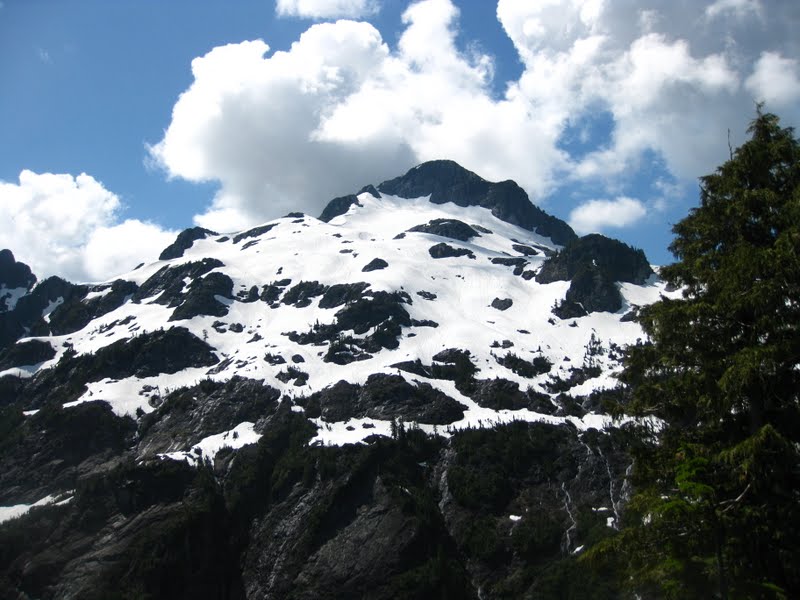
Photos of Tricouni Peak in Paradise Valley, British Columbia.